Hakka Gongfu Defined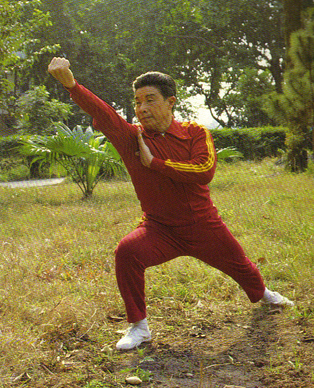
Master Chen Chang Mian
Note: Master Chen Chang Mien is a master of Southern Fist (南派 – Nan Quan) and at the time of writing his book, was a well-known martial arts master in Southern China, as well as recognised as the Guangdong province regional master for Wu Shu (武術) or ‘martial arts’. Nan Quan is a combination style that integrates elements from the many different local systems of gongfu (功夫) in the provinces south of the Yangze River such as Fujian, Guangdong, Guangxi, Hunan, Sichuan, Jiangxi, Zhejiang, and Jiangsu. The Hakka or ‘Guest People’ migrated into the Southern areas of China over a period of more than a thousand years, bringing their northern martial culture with them. Following the Hakka-led Taiping Uprising (1850-1864), and the Hakka-Punti Clan Wars (1855-1867), northern Hakka martial culture was suppressed, and many original Hakka styles either died-out, or were altered to look more ‘Southern’ in nature in an attempt to hid their Hakka origins. This is why today many Hakka styles look ‘Southern’ – but not all. Like the Ch’an Dao System (referred to as ‘Chan Gar’ or ‘Chin Gar’ - 陳家 - in the local Sai Kung Hakka dialect) some northern Hakka styles survived in areas away from the central Qing authorities – particularly in the British colony of Hong Kong. However, regardless of any changes of the outer structure of the Hakka fighting arts, there are certain characteristics that all Hakka styles share and Master Chen below offers a concise definition of Hakka martial arts. I have added clarifications in brackets. ACW 7.3.2016
'Hakka Quan (客家拳 – Ke Jia Quan) is the general name of the shadow-boxing of the Chu School, School, Tiao School, and Niu School, etc. As they are popular in such Hakka areas as Meixian, Xingning, Huiyang, etc., they are called by a joint name of Hakka Quan (in Southern China). Its features of motion are; squatting half down (Horse Stance), bowing a leg slightly forward and squatting a little down (Dragon Stance) are the postures of the legs mostly used; squatting with one foot in front and the other behind (Free Stance) and squatting leisurely with both legs crossed (Unicorn Step) are its main footwork; draw the chest in and retain the breath (qi energy); it is good at exerting forces briefly (i.e. sudden and explosive bursts of powerful energy that stem from the complete alignment and relaxation of the body); this school has more such movements as throwing oneself onto the ground and making rolls (Ground Fighting); it is fast in moving the legs with good short exertions.' (Extracted from Kung Fu in South China: By Chen Chang Mien, Wan Li Book Co. Ltd, Hong Kong, (1990), Page12) |