|
We train when we are young because we do not yet appreciate what ageing is. Yes - we see ageing all around us in the plant and animal kingdom - and it is usually through the trauma of a deceased pet that we first experience the sadness and grief of the permanent "separation" associated with death. We might also experience the passing of an older relative - usually a grandparent or the like - with some suffering the tragedy of losing a sibling or a parent at a relatively young age. On top of all this are the unseen shadows cast by accidents and criminality. In-short, "death" might come knocking at any time with the proviso that the decent adults around us tend to act as an emotional buffer-zone. This is important as when young we are adults in training so that one-day we might take our place on the frontlines of life and robustly shoulder all the difficult tasks allotted to us. For some generations this duty might extend to actually fighting in bloody wars - and so the cycle turns. For the traditional and sporting martial artist - our bodies are our weapon. Although our bodies constitute the biological machine into which "we" are born and from within which our individual "consciousness" derives - in the early days of human evolutionary existence - the body was also the means through which outside threats were absorbed (in the sense of "blows") and dealt with (in the sense of counter-reactions). Later, the human brain developed the ability to utilise the environment to assist this survival capability. A stone and a stick could be individually used to attack and defend (the early meat-eaters attacked and killed their prey) against the enemies of humanity. When the stone was tied to the stick - humanity's first "super-weapon" was devised - bestowing an insurmountable advantage at the time. Others initially did not understand how this weapon was made or used - but all could see its dreadful efficacy. Physical dominance through power also began the political stratification of human society premised upon the "haves" and the "have nots". Eventually, whilst one group lorded it over another - it became obvious that regardless of how humanity organised its internal structure - there were very real external enemies that offered immediate threats to ongoing human survival. To combat this, it became obvious that what advantaged a certain strata of society had to be taught to each new generation so as to retain the shape of human society within whilst defending the human species from external attack. As the early martial arts were linked to a) nature, and b) the "unseen" world of the spirit - the physical shapes chosen were those assumed by different animals - together with their different attitudes. This formed the basis of Chinese martial arts - usually practiced as part of a shamanic ritual that opened a door between this (material) realm and the (unseen) spiritual realm - the place dead people were assumed to have departed upon death. From what I gather, all early human gatherings pursued this path of development across the globe - which explains why the British Celtic culture has distinctly "Daoist" undertones whilst possessing no direct link with China. All human groupings evolved out the same material stuff with its distinct and diverse peculiarity (the animals and environment may differ - but all this stuff exists within "nature"). In the modern and post-modern era - the individual does not need to practice traditional martial arts as industrialised warfare has moved on - so as to render individual bravery more or less redundant. Tens of thousands can be wiped-out with modern missiles without ever taking to the battlefield or engaging with the enemy. As the contemporary authorities tend to view the traditional martial arts as an anachronism - they tend not to be bothered by their existence or practice (as the training is unnecessarily arduous for no real material gain). Although the bodily movement may be perfected to a vey high degree - and the mind inwardly developed to a rarefied level of perception (perhaps akin to that of Medieval monks alleviated to Sainthood). Indeed, this is what martial artists "choose" to do in the modern era - for no real reason at all. For each individual, the voluntary practice of a spiritualised martial art links each contemporary person to their ancient ancestors. As it is broadly linked to "spirituality" (any form of spirituality either defined or not defined) - its practice is viewed as "morally" uplifting, good, and wholesome. All this being said, those of us who are committed to this path understand just how sophisticated this traditional martial practice is - and this is true regardless of whatever strand it is that we choose to follow. Regardless of "difference" in style, or origination, (and despite the "differences" that might exist) - we all have to follow distinct phases of practice - which many followers never complete (some practice for a time and then life takes them in other directions). For those of us who are fated to practice into old age - we must spend time practicing the physical technique in isolatory and collective practice - whilst learning from those "who know" - before learning how to teach others and act as a role-model in society. Despite how difficult this is (which varies according to inner structure regarding grading, non-grading, and sometimes sporting success - together with honour fights and all types of unusual challenges) this is not the higher levels of mastery. This level of mastery involves perfectly understanding how the inner and outer body functions and manifests - and how the conscious mind permeates every atom and cell with light. As we age, the body changes according to a learned evolutionary response to existence. To clear the way for the next generation of youthful vigour - the older generation possesses a genetic programming which see the body sabotage its own operation through the cellular structure slowing falling apart. Medicine can prolong this process - but it cannot stop it (as matters stand). Each of us "masters" must navigate our way through this process by keeping a constant mind-set that sets an example for the youth (who are not yet able to comprehend exactly what death is). On top of this, although our advanced martial arts ability (which is perfected perhaps in middle-age - sometimes earlier - occasionally later) - this transcendent ability must continue to be expressed regardless of age or state of the older body. An older body might be ill, injured, or otherwise disabled - whilst the spiritual (mindful) centre of each individual must retain the ability to "shine" with positivity and light into the void that is death. Furthermore, even an ill or disabled body when young can still perfect martial arts in this capacity - with the body's dysfunction simply being yet another problem that must be conquered and transcended. This is similar to overcoming injuries suffered by those who do not possess a disability.
0 Comments
The ceramic equestrian figurine (Photo/Jiangsu Provincial Department of Culture and Tourism) A ceramic equestrian figurine featuring the world's earliest image of a stirrup has been found at the family tomb of Ding Feng, who was a general of Three Kingdoms period (220-280), in Nanjing, East China's Jiangsu Province, pushing back the record of stirrup usage by 31 years, according to the Jiangsu Provincial Department of Culture and Tourism.
Among the cultural relics unearthed from the tomb, the 20-centimeter-tall figurine ceramic horseman stood out due to a triangular stirrup visibly hanging on the left side of the horse's belly. This discovery has been described as a revolutionary one in the field of ancient military history, according to materials sent to the Global Times on Sunday. The figurine has been dated to 271, the year of Ding's death, establishing it as the earliest-known representation of a stirrup globally. This discovery pushes back the record by 31 years from the previous holder -a ceramic figurine from a Western Jin (265-316) tomb discovered in Changsha, Central China's Hunan, dated to 302. The figurine depicts a rider wearing a small round hat, sitting upright on the horse. While the rider's arms and left leg are missing, a stirrup is clearly visible on the left side of the horse. Notably, the rider's missing left foot was not placed in the stirrup, indicating that this single-sided stirrup was primarily used as an aid for mounting the horse rather than for balance or riding stability. On the right side of the horse, both the horse's belly and the rider's leg remain intact, yet no stirrup is present. This proves that the stirrup was a mounting tool rather than a feature for both feet. "This finding marks the first discovery of a glazed ceramic equestrian figurine in Nanjing," said Zhou Baohua, a researcher from the Nanjing Archaeological Research Institute. "The presence of a single-sided stirrup on the figurine shocked us. The stirrup was a critical innovation for cavalry and mounted archery, significantly enhancing their effectiveness. "Zhou noted in an interview with the Jiangsu TV. Before the invention of the stirrup, riders relied solely on their legs to grip the horse and depended on one hand to steady themselves on the saddle. This made it nearly impossible for soldiers to engage in combat while mounted. The introduction of the stirrup revolutionized cavalry warfare by freeing the rider's hands, enabling them to wield heavy weapons and engage in close-range combat with greater stability and efficiency, Liu Zheng, a member of the China Cultural Relics Academy, told the Global Times on Sunday. Liu added that the stirrup originated from China also impacted the whole world as this invention made cavalry an important force in the era of cold weapons. British historian Joseph Needham noted that "the stirrup, invented in China, revolutionized medieval European cavalry tactics." In the West, stirrups were often referred to as "Chinese boots." Their introduction enabled the establishment of new cavalry tactics, leading to the rise of the chivalric system that defined medieval European society. The city of Nanjing is also home to another world record related to stirrups. The earliest known depiction of a pair of stirrups was discovered in the tomb of Wang Yi, the uncle of the calligraphy master Wang Xizhi. A ceramic horse figurine from this tomb features a pair of stirrups, establishing it as the world's earliest-known artifact featuring double stirrups. The earliest physical evidence of stirrups was unearthed in Chaoyang, Northeast China's Liaoning Province. This site produced the largest collection of stirrups, showcasing a wide variety and including the earliest examples, all discovered in pairs, the Xinhua News Agency reported. Email: Remembering Rose Lee - Who Showed How "Honesty" Is the Best Way to the Internal! (11.6.2025)6/11/2025 Dear O
When Rose Lee retired from full-time teaching in the 1990s - she sent one of her long-term Taijiquan students (James) to me. He had trained with KF and this is what he said: 'I paid £200 in advance for what I thought was a private session. When I turned-up at the address - it turned-out to be lecture hall - with 50 other people present. KF came out on time and explained he was "too busy" to stay the full hour and that he had filmed the lesson on a 15-min VHS tape. He said we could watch the video "once" - and discuss its content for 45-mins before leaving to make way for the next class. A copy of the tape was £50 for one - £80 for two - and so.' He then walked out the lecture hall whilst two of his full-time students "monitored" the group. I believe this was the late 1990s-early 2000s. James did not exclusively train with me and did not learn the gongfu - the deal seemed to be Taijiquan only - and I allowed it due to my respect for Rose Lee. As for DY - I can only say what others told one of my Chinese students. They said his Longfist did not match the lineages he claimed to represent - with others questioning how it was that he had managed to master so many styles - usually a correlation equalling the number of books he has for sale at anyone time. Now, I do not really know - and you must think for yourself - which I am sure you already do. On a lighter note, I was told about year or so ago - that my style was mentioned on a racist US martial arts site that sets itself up as an arbiter of Asian combat culture. Apparently, this is a single entry from 2011 of all dates! I had honour fights from 1994 to around 2008 - about 100 in all (no pads - no rules) in front of witnesses - and prevailed through them all as tradition demands - but there were some unhappy bunnies (we think one of these made the post in question). From 1994-1998 these fights almost always involved disgruntled ethnic Chinese people looking to finish me off in front of my Chinese family and saving the face of the Chinese community. Imagine that! I used to get these out the way a few minutes to 10am on each Sunday morning so that the classes proper could start. Occasionally, these fights might happen at 11am - as the gongfu section came to an end - with the next hour being strictly internal. These fights were malicious as the opponents were motivated with anger and hatred of an ancient culture - which I respect. As a Buddhist by birth - I like fighting (but dislike greed, hatred and delusion) and I partake with an attitude rather similar to my Muslim brothers. I have always had a good relationship with the Islamic community and was even honoured with teaching a group of their children in Sutton. I think that although we inhabit a material world - the channel to the internal can only happen through a spiritual method. Honesty seems to be the deciding factor. Certainly - when I first saw Goju Ryu in the Hereford Leisure Centre - I couldn't believe my eyes! To that point, I had only seen and physically experienced Wado Kai, Shotokan, and Shukokai - all Japanese arts - but never Okinawan styles. My teacher (Master Chan Tin Sang) told me Karate-Do had come from China - but that the Japanese had altered its physical techniques (deliberately removing the distinctly "Chinese" internal aspect) so that the transplanted arts now resembled Japanese sword arts. Bear in mind that this generation of Hakka-Chinese had just fought a brutal war with the Imperial Japanese - so Okinawa was always viewed as "Chinese" (or so I learned later). Remember, I was only in my mid-teens myself and did not understand things that clearly. As matters stood, I experienced three Japanese Karate-Do styles - and then I learned the basics of Goju Ryu from your good-self - and my gongfu teacher was astonished! He couldn't believe the integration of hard and soft! He kept asking me who you were and where you had trained! One time (during 1987) Master Chan came to Hereford to see me - and looked in at your class. He was too shy to interfere - as he wasn't sure of the Japanese involvement (if any) - and I didn't really know (for which he told me off). Until he passed away in 1993, he would sit at dinner-time and tell his Hakka friends about Goju Ryu - and get me to show the basic kata. The circular lower block seems to be the most obvious of the "internal". Tony: On Tue, 22 Apr 2025, at 10:29, "morning Adrian. What are your views on this
Softness as regarding techniques. You can plainly see the Chinese influence. Tony" Traditionally speaking, the graves of Chinese ancestors are tended to twice a year - in the Spring and the Autumn. This is a matter of Confucian respect. The family lineage - or surname of "Chan" (陳) - is empowered through the exercise of the correct ritual. Just as qi (氣) energy flows through the individual body - qi energy flows through the collective (community) body (i.e. family and extended family). Furthermore, qi energy flows like a river from the past to the present, and from the present to the future. Confucian ritual recognises and strengthens this process - renewing it with each performance. It is the qi energy that enthuses all the Chan Family gongfu movements - and which makes the art effective in combat. Indeed, these rituals ensure that the gongfu style remains effective and does not lose its connection with its Chinese cultural past. Most other lineages of gongfu - which exist only to make monetary profit - possess NO genuine connection with any aspect of Chinese culture or history. As such - they are doomed to fail in combat.
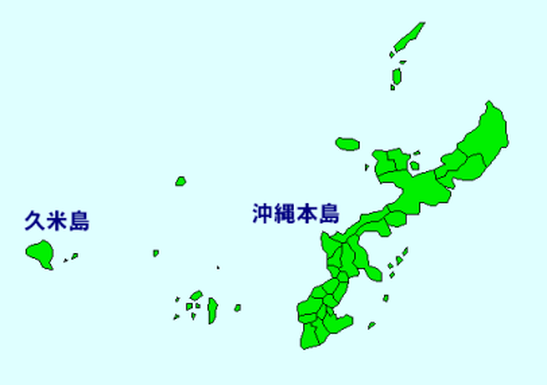
The Island known as ‘Okinawa’ lies off of the South-West coast of Japan - forming part of the Ryukyu Island Chain - and is expressed in Japanese (Kanji) ideograms as ‘沖縄’. This name may be deconstructed as follows: a) oki (沖) = expanse of open water b) nawa (縄)= rope or thread The name appears to be a direct description of the numerous islands that comprise ‘Okinawa’ – which are themselves a substantial (Southern) part of the larger Ryukyu Island Chain. Perhaps the geographical placement and general shape of the islands was seen from high mountain-tops, surveyed in passing ships and/or observed from upon high by those who flew in the ‘Battle Kites’ known to exist within medieval Japan. Whatever the case, the Okinawa Island Chain is said to resemble a meandering rope lying across the surface of the water. I have read that this area first became known to China under the Sui Dynasty (581-618 CE) – but was not formally recognised by the Imperial Court until the Tang Dynasty (618-907 CE). This is when diplomatic and cultural contact with the King (of what was then termed the 'Liu Qiu' [琉球] Islands) was established - known today by the Japanese transliteration of 'Ryukyu'. 琉 (liu2) = sparkling-stone, jade, mining-stone (from previously uncultivated land), precious-stone, arriving, and breaking through (to a place far away - and situated on the fringes of the known world) 球 (qui2) = beautiful-jade, polished-jade, refined-jade, jade percussion instrument, earth, ball, and pearl. The Chinese Mariners must have been taken with the beauty of the Ryukyu Islands - as the term '玉' (yu4) – or ‘jade’ - appears as the dominant left-hand particle of both ideograms forming the name ‘Liu Qiu’. From the Tang Dynasty onwards, the Liu Qiu Islands were considered a distant (but important) part of the Tributary System of Imperial China. In return for a continuous show of annual respect (usually in the form of expensive gifts and/or elements of trade, etc) China shared her extensive culture. It was not until 1872 CE, however, that Imperial Japan took decisive action to annex all of the ‘Ryukyu’ Islands – and it was around this time that the term ‘Okinawa’ was developed to describe the Southern two-thirds of the Ryukyu Island Chain – now a ‘Prefecture’ of Japan. This history explains why the ideograms for ‘Okinawa’ are written in (Japanese) ‘Kanji’ - and are not obviously ‘Chinese’ in structure (as is the far older name of ‘Liu Qiu’). Is it possible to ‘reverse-engineer’ the Kanji ideograms associated with the name ‘Okinawa’ (沖縄) and work backwards as it were – to the original Chinese ideograms? The answer is ‘yes’ – as such an exercise might well shed some more light on the meaning of the name itself. Japanese - 縄 (nawa) = Chinese – ‘繩’ (sheng2) When adjusted in this manner - the Japanese name of ‘Okinawa’ (沖縄) is rendered into the Chinese language as ‘Chongsheng’ (沖繩). Whereas the first ‘Kanji’ ideogram of ‘沖’ (oki) remains identical with its Chinese counterpart of ‘沖’ (chong) - the second ‘Kanji’ ideogram (縄 - nawa) undergoes a substantial modification (繩 - sheng). From this improved data a more precise definition of the name ‘Okinawa’ can be ascertained through the assessment of the Chinese ideograms that serve as the foundation of the Kanji ideograms – working from the assumption that this meaning is still culturally implied through the use of ‘Kanji’ in Japan – even if such a meaning is not readily observable within the structure of the ‘Kanji’ ideograms themselves. 沖 (chong1) is comprised of a left and a right particle: Left-Particle = ‘氵’ which is a contraction of ‘水’ (shui3) – meaning water, river, flood, expanse of water, and liquid, etc. Right-Particle = ‘中’ (zhong1) refers to the concept of something being ‘central’, in the ‘middle’, or being perfectly ‘balanced’. It can also refer to an ‘arrow’ hitting the ‘centre’ with a perfect ease. Therefore, the use of 沖 (chong1) in this context - probably refers to an object that centrally exists within a body of water. 繩 (sheng2) is comprised of a left and right particle. Left-Particle = ‘糹’ which is a contraction of ‘糸’ (mi4) – meaning something that resembles a ‘silken thread’, a ‘thin’ and ‘flexible’ cord, a ‘rope’ or ‘string’, etc. This may also refer to the act of ‘weaving’ or to an object (like a rope, string, or strand) which is ‘woven’ into existence – perhaps implying a ‘cohesion’ attained through an ‘inter-locking’ agency, etc. Right-Particle = ‘黽’ (meng3) – this was originally written as a depiction of a type of frog – but evolved to be used generally to describe the act of ‘striving’, ‘endeavouring’, or ‘working hard’ (nin3). However, I am of the opinion that more practical attributes are at work in this instance. An old (but simplified) version of this ideogram is ‘黾’ – which demonstrates a clarification of what used to be a ‘frog’: This explains why there is said to be an ‘upper’ and ‘lower’ element to this particle: Upper-Element = ‘口’ (kou3) – signifies an ‘open mouth’, ‘entrance’, ‘mouth of a river’, and ‘port’. This can also denote a ‘boundary’ and a ‘hole’ or ‘indent’. This used to represent the head of a frog. Lower-Element = ‘电’ (dian4) – denotes ‘forked-lightning’, ‘energy’ and ‘electricity’, etc. Although evolving from the body of a frog – this element conveys not only the overt power of lightning – but perhaps retains something of the ‘shape’ of forked lightning in its usage as a noun. Perhaps 繩 (sheng2) is a descriptive term used to describe a port that allows entry to a string of islands which seem to take the shape of a rope that geographically unfurls - like forked lightning traversing the sky. Conclusion The term ‘Chongsheng’ (沖繩) – or ‘Okinawa’ - probably refers to a string of islands (and ports) which exist within a broad expanse of open sea - like a rope floating upon the surface of the water (the shape of which resembles that of forked-lightning). This place may be difficult to reach – and the people encountered may be very hard working. It is highly likely that these islands seem to float like a frog on the surface of the water – hence the selection of these ideograms. Of course, the post-1872 Japanese Authorities chose to use the Kanji ideograms of ‘沖縄’ to convey the concept and meaning of the name ‘Oki-Nawa’. In Chinese language texts, I do not see Okinawa referred to as an isolated unit of geographical description. This is because Chinese literature refers to the entire Chain of Islands by the far older and more traditional name of 'Liu Qiu' (琉球) – which was politically acknowledged through ancient diplomatic exchange. Furthermore, it is interesting to note that the post-1872 Japanese Authorities did not abolish this Chinese name – but borrowed it – simply transliterating it into the now well-known ‘Ryukyu’ Islands. Okinawa is only around two-thirds of the Southern-Central area of the Ryukyu Islands – but as far as the ancient Chinese were concerned, the ‘King of Ryukyu’ was the ‘King’ of the entire geographical area defined by this term. Whereas the Chinese term is prosaic (poetically speaking of ‘jade’ and ‘unexplored’ land – the Japanese term might well be practical as it seems to be describing the ‘rope’ that is extensively used in sailing ships, boats, and other floating entities – including the requirement to ‘moor’ such objects in purpose-built ports. The difference in the two-names probably reflects the developing socio-economic conditions prevalent throughout the Island Chain at the time of conception – with around 1500 years separating the development of the two names. Chinese Language Text:
Dear Charles! The remarkable true-story of this African man was told to me today - so I did a little research digging: You may have already heard of this person - but its news to me! His name is written in traditional Chinese characters but pronounced in the Japanese language - which was typical for the 16th century Japanese culture of the day 彌 (mi1) (Ya) = a 'long distance', to 'stop' or 'put down' and 'to relax a drawn bow' 助 (zhu4) (Suke) = to 'help', 'aid' and 'assist' Therefore '彌助' ('Mizhu' or 'Yasuke' could mean the 'tall' person, the 'martial' person (as in possessing good 'self-control') or the person from 'far-away' - who is an 'able' and good 'retainer'. 'Yasuke (b.1556-d.?) was a Retainer (Samurai) of the Daimyo known as - Oda Nobunaga - during the Warring States Period in Japan. Yasuke is famous as being the first 'African' (Black) warrior in Japanese history.' One story I read in Chinese language sources talks of the troops of Oda Nobunaga attacking an area controlled by Ninja Clans. As can be expected - the fighting was ferocious with the Ninjas fighting very much like the Vietcong and causing all kinds of enemy casualties through ingenious and under-hand methods! At one point in the fighting - Yasuke - is ambushed whilst alone by a group of Ninja warriors, but he draws his katana shouting 'My Lord is invincible!' - and proceeds to advance and carve his way through his assailants! However, soon he is completely surrounded and in a desperate position! At this point Lord Oda Nobunaga himself arrives on the scene with his warriors and after seeing Yasuke holding-off dozens of living Ninjas (as well as piles of dead Ninja bodies) he orders his immediate rescue! Best Wishes Adrian
Blogger's Note: The Chinese martial arts manual mentioned in the below referenced article is termed the '易筋經' or the 'Yi Jin Jing' (or the 'Change Muscle-Tendon-Energy Channel Classic'). Within myth and legend, this manual is said to have been brought to China from India c. 520 CE by the Indian Buddhist monk known as 'Bodhidharma' (who is believed to have 'transmitted' the 'Dhyana' or 'Ch'an School of Mahayana Buddhism to China). My personal opinion is that the data contained in this manual may have been passed on orally - between Master and Disciple - for centuries BEFORE finally being written down and then evolving into the form known today. If this is not the case, then the Yi Jin Ying is a Qing Dynasty construction reflecting key elements of ancient Chinese martial arts practice - ascribed to mysterious and exotic origination! Perhaps the reality is a bit of both. Whatever the reality, the idea of the (Putonghua) '點穴' (Dian Xue) or 'Strike Point' concept and the '點脈' (Dian Mai) perhaps more readily known in the West by its 'Cantonese' expression of 'Dim Mak' (or 'Strike Channel') are well-known concepts within traditional Chinese martial arts. Within Traditional Chinese Medicine (TCM) - these two terms refer to the same gongfu process of striking the exterior (and 'interior') of the opponent's body in such a manner that the 'Qi' (氣) vital force energy flow is either temporarily or permanently disrupted. This is designed to cause injury along a sliding scale of inflicted damage ranging from a minor (and short-lived) disruption of bodily functions - to devastating damage caused to the internal organs and deep bodily structures - designed to cause 'death' (indeed, it is believed that a true Master can 'strike' a specific medical point even without the opponent knowing - causing death many hours later). It may well be that '精' (Jing) or 'essential nature' and '神' (Shen) or 'expanded empty consciousness' are also 'disrupted' by using this gongfu method - but in different ways. An opponent may be psychologically 'unbalanced' by the presence of his adversary (disrupting 'Shen' with no actual blows being struck) or have the 'Jing' flow disrupted (if opponent is 'male') through a blow delivered to the genitalia or anywhere along the 'Conception' and/or the 'Governing' Vessels, etc. Of course, a powerful blow may be intended to only hit the 'outside' of the physical body structure of the opponent - or be designed to 'penetrate' through these external structures and 'pierce' the inner organs and deep bodily structures. This type of 'hitting' is a routine requirement in the mastery of traditional Chinese martial arts. The concept of '導引' (Dao Yin) or to 'Direct Stretch' - is the traditional foundation for the modern practice known as '氣功' (Qi Gong) or 'Vital Force Energy Cultivation'. ACW (13.4.2023) 2023-04-12 Ecns.cn Editor: Zhao Li (ECNS) -- In Chinese costume dramas, people often see a miraculous martial arts skill called Dian Xue (acupoint), which uses pressure points to control or immobilize an opponent. Dian means to strike with a finger and Xue means an acupuncture point. During fights, martial arts experts use their two fingers to swiftly and forcefully press on a certain part of the opponent's body, immediately immobilizing them. Compared to Dian Xue, the Yi Jin Jing in martial arts novels is even more miraculous. Yi Jin Jing is known as a classic book about Muscle and Tendon Changing. “Yi” means to change, “Jin” means tendons and muscles, and “Jing”, methods. Legend has it that anyone who masters the skills in this book can become a master of martial arts and even save others' lives, so martial artists eagerly pursue it. According to legend, credit for Yi Jin Jing's development is given to Da Mo (Bodhidharma), an Indian monk who lived in the Song Mountains in central China. Legend said that Yi Jin Jing was left behind by Bodhidharma after he departed the Shaolin Temple. However, there is some debate about the true origin. But Zhou Weiliang, professor at Hangzhou Normal University, believes that in reality, Dian Xue and Yijin Jing are not as mysterious as they are portrayed in television dramas. Yi Jin Jing includes the Dao Yin exercises and martial arts exercises. It emphasizes that the core of martial arts lies in internal strength, which is manifested from the inside out. There are no specific martial arts movements in the book. It mainly introduces some exercises to cultivate inner strength. The Dao Yin exercises are related to health preservation via meditation and practicing breathing. In Qing Dynasty (1636 -1911), some stories mentioned the book Yij Jin Jing. Zhou said that many Qing Dynasty notes are similar to novels, and recorded events are more like stories, in which Yi Jin Jing was described as a "secret martial arts manual". Zhou believes that some of the descriptions of Yi Jin Jing in current Chinese martial arts novels may have adopted this setting from historical materials of the Qing Dynasty while adding more rich and complex plot lines. Yi Jin Jing also introduces finger strength training, which involves placing mung beans in a container and repeatedly inserting fingers among the beans to strengthen the hand. Over time, the fingers become as hard as stone and no one can resist them Some people believe that this may be one of the legendary Dian Xue techniques. However, Zhou believes that the ability to immobilize people with this technique may not actually exist. The miraculous effects are mostly exaggerated in novels and movies. English Language Article:
http://www.ecns.cn/m/news/cns-wire/2023-04-12/detail-ihcnkeae0516413.shtml The below text regarding the White Crane Fist history of Goju Ryu Karate-Do - states that Miyagi Chojun was interested in Go Genki's 'Crane Hand': This White Crane Fist concept is written in Japanese script as '鶴の手' or 'Kaku no te' (literally 'Crane of Open-Hand') - probably better rendered as 'Open-Hand of the Crane'. It is interesting that 'Kaku' (Crane) sounds like ‘Kakie' - the name of the ‘Pushing-Hands’ practice found within Goju Ryu. I am considering whether the ‘name’ of this concept (i.e., Crane or ‘Kaku’) was eventually replaced by a description of the activity’ itself (Push-Hands) - with ‘Kaku’ (か) verbally morphing into ‘Kakie’ (カキエ) - when passed on from Master to Disciple before being recorded in writing with slightly different Japanese characters (although the ‘カ’ particle remains constant). An interesting observation can be gained from the title of the below linked video: The 'Chinese' and 'Japanese' ideograms for 'Crane' are included in the title of this video. a) 鶴 (he4) - Chinese - read in the Japanese language as either 'Kaku' (か), 'Tsuru' (つる), 'Zu' (ず), or 'Tazu' (たづ), etc - there is no way of telling 'how' it should be pronounced in Japan and depends upon a culturally relevant context. b) ツル (Tsu - ru) - This is Japanese Katakana for 'Crane' or 'long-legged and long-necked bird of the family Gruidae'. Although it would seem that the Chinese ideogram '鶴' (he4) is interpreted as 'Tsuru' (つる) - but not 'Kaku' (か) - at least in the video title above, or perhaps by modern convention. However, the '鶴' (he4) is still pronounced as 'Kaku' (か) within Japanese language dictionaries - and I am considering if 'Kaku' (か) was originally used 150 years ago - hence its similarity (and apparent) relationship to 'Kakie' (カキエ). If this association is just a coincidence - it is extraordinarily poignant.
Dear T
With regard to 'Muchimi' (ムチミ) - 'heaviness', 'rooted': When I was younger (and less experienced in translation), I probably would have been tempted to read the Japanese (Katakana) character of 'チ' (chi) - or 'one thousand' - as being related to the Chinese ideogram of '手' (shou3) - meaning 'open hand' (and to 'clutch', etc), as they look very similar in structure. My instinct would have led me in this direction considering the martial arts usage related with the term 'Muchimi' - applying a logical 'reverse chain of events', so-to-speak (in other words - 'working backwards' using logical association). However, all the multi-language dictionaries I have access to today - strongly suggest there is no connection between these two characters. As this possible association played on my mind (in the sense that no stone should remain unturned), I checked '手' (shou3) in these dictionaries (focusing on the 'Japanese' variants) and found that even today - the Chinese ideogram of '手' is still often used - 'unchanged' - within Japanese script, usually rendered as 'te' or 'shu', etc. When '手' is modified within Japanese script - it is presented as 'テ' (Katakana) and 'て' (Hiragana) - pronounced 'te' and 'shu' respectively. Therefore, although the 'チ' (Katakana) character found within 'Muchimi' (meaning 'one thousand') is 'similar' to the (Katakana) character 'テ' (te) - meaning 'open hand' - as you can see, there are slightly different upper structural differences - despite a certain lower level similarity. After further studying the history of each of these specific Japanese (Katakana) characters - the lower similarity appears to be purely coincidental rather than deliberate. The conclusion being that there is no connection between the 'チ' (Chi) - one thousand -Japanese (Katakana) character and the '手' (shou3) - meaning 'open hand' - Chinese ideogram. Best Wishes Adrian |
AuthorShifu Adrian Chan-Wyles (b. 1967) - Lineage (Generational) Inheritor of the Ch'an Dao Hakka Gongfu System. |
RSS Feed